

Last Updated: October 25, 2026
Quick Summary
To spot quality cotton tees, read the sewn-in fiber tag, check the fabric weight in GSM, and inspect the stitching. Look for 100% cotton, 180-220 GSM for daily wear, double-needle hems, and a ribbed neckband that snaps back. A three-wash test then confirms shrinkage, pilling, and seam performance.
- Cotton accounts for around 52% of total T-shirt market demand, per Printful's industry statistics.
- Most durable cotton tees use 10-12 stitches per inch on main seams; fewer than 8 SPI signals a weak seam.
- Pre-shrunk cotton should hold within 3-5% shrinkage, about 0.5-1 inch on a 20-inch chest.
- Stretch the neckband about 1 inch and release; if it returns to shape immediately, the rib has good recovery.
- A 1-inch or wider hem with double-needle stitching holds shape better than a narrow 0.5-inch hem.
Table of Contents
- Why Cotton Quality Matters More Than the Label
- How to Tell If a Shirt Is 100% Cotton
- Cotton T-Shirt Fabric Weight and GSM Explained
- Combed Cotton vs Ring-Spun Cotton: What Changes in the Hand Feel
- How to Check T-Shirt Stitching Quality
- A Repeatable In-Store and At-Home Inspection Checklist
- Care Testing and Long-Term Performance
- Choosing Quality Cotton Tees at PureSaltVibes
- Frequently Asked Questions
Why Cotton Quality Matters More Than the Label
Cotton accounts for around 52% of total T-shirt market demand, according to Printful's T-shirt industry statistics and trends.
This guide from PureSaltVibes breaks down how to spot high quality cotton tees using cues like fiber content, fabric weight, stitching, and care performance.
Most shoppers buy on price or brand. A WRAP study on garment durability found that price was not a reliable indicator of how long a T-shirt lasts.
What actually predicts quality is fiber type, fabric weight, yarn structure, and construction. We walk through each, then give you a repeatable checklist.
How to Tell If a Shirt Is 100% Cotton
The fastest way to tell if a shirt is 100% cotton is to read the fiber content on the garment tag. By law in most markets, that tag lists every fiber and its percentage. A true all-cotton shirt says "100% cotton" with nothing else listed.
Reading the Garment Tag and Fiber Content
Start with the sewn-in label, not the hangtag. Hangtags are marketing. The sewn-in tag is regulated.
- 100% cotton: one fiber listed, no blends.
- Cotton blend: cotton mixed with polyester, elastane, or rayon. Often softer drape, less breathability.
- Tri-blend: cotton, polyester, and rayon together. Very soft, but pills faster.
Check where the cotton comes from too. A OEKO-TEX Standard 100 certification means the finished garment was tested for harmful substances.
Watch out: a tag that says "cotton-rich" or "cotton feel" is not a fiber content claim. Those phrases are marketing language with no legal definition.
The Limits of At-Home Fiber Tests
You can burn a loose thread to guess fiber content: cotton burns fast, smells like paper, and leaves gray ash, while polyester melts and beads.
Treat at-home tests as a sanity check, not proof. If a seller claims 100% cotton and the burn test beads up, walk away; if it ashes cleanly, you still need the tag and fabric weight to judge quality.
Cotton T-Shirt Fabric Weight and GSM Explained
Fabric weight is the most useful number on a spec sheet, telling you how thick, opaque, and durable a cotton tee will be.
Here is how the ranges break down:
| GSM | Ounces | Feel | Best For |
|---|---|---|---|
| 120-150 | 3.5-4.4 | Very light, sheer | Summer layering, warm climates |
| 150-180 | 4.4-5.3 | Lightweight, breathable | Everyday basics |
| 180-220 | 5.3-6.5 | Midweight, structured | Year-round wear, prints |
| 220-260 | 6.5-7.7 | Heavyweight, substantial | Oversized fits, durability |
| 260+ | 7.7+ | Very heavy, stiff at first | Workwear, streetwear |
A 250 GSM cotton tee, like our Surf design Snow Washed Oversized Cotton T-Shirt, holds its shape and drapes with weight.

Heavier is not automatically better. A 250 GSM shirt in July heat feels like a blanket.
Combed Cotton vs Ring-Spun Cotton: What Changes in the Hand Feel
Combed cotton has short fibers and impurities removed before spinning, making it smoother and stronger. Ring-spun cotton is twisted continuously during spinning, aligning fibers into a softer, denser yarn.
Neither is "better" in isolation, cheap combed cotton can feel rougher than good ring-spun. The combination matters: long-staple fiber, combed, then ring-spun, gives the softest, most durable result.
Yarn Count and Single Count in Plain Terms
Yarn count tells you how fine the yarn is: "40 single" is finer and softer than "30 single," and costs more to produce. A 40 single combed ring-spun tee feels noticeably smoother than a 30 single regular cotton tee at the same weight.
Our Sorry I missed your call I was surfing Unisex Garment-Dyed T-shirt uses 100% ring-spun cotton at 206.8 GSM. That combination gives a soft hand feel with enough weight.
Surf design Snow Washed Oversized Cotton T-Shirt →

How to Check T-Shirt Stitching Quality
Stitching quality is where a cotton tee either survives fifty washes or unravels at twenty. Here are specific construction details to inspect, with pass/fail cues, so you can judge a shirt in the store or from product photos.
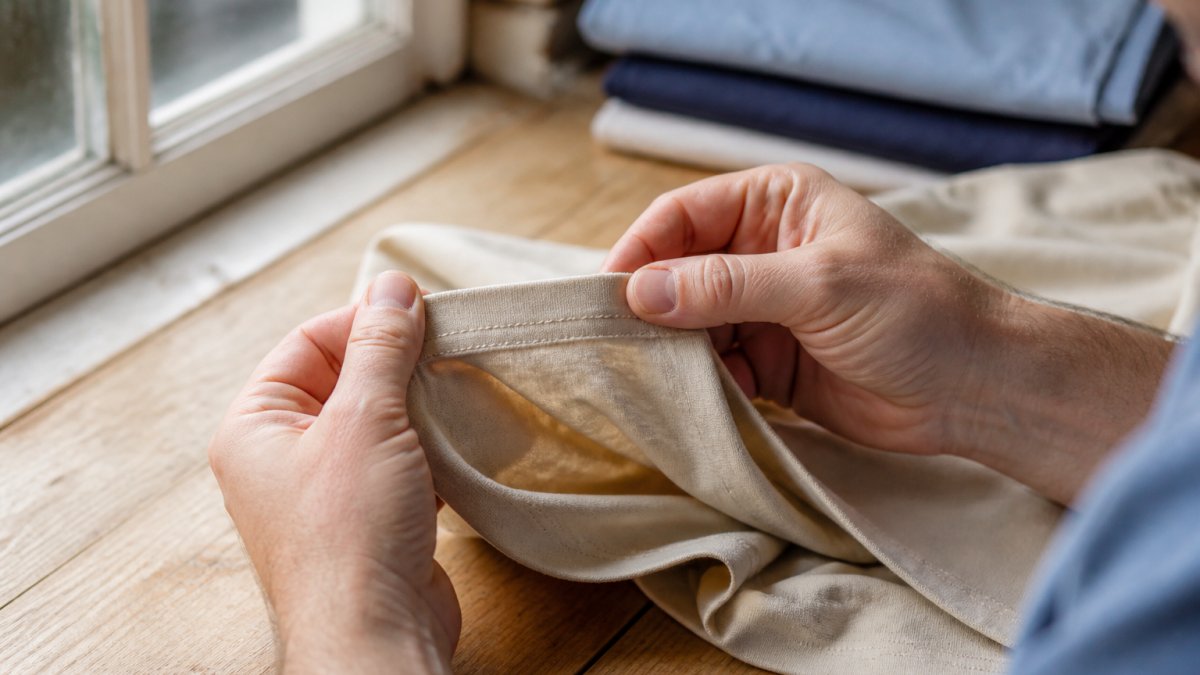
Stitch Density and Seam Type
Stitch density is the number of stitches per inch (SPI). Most durable cotton tees use 10-12 SPI on main seams. Fewer than 8 SPI signals a loose, weak seam that will gap. You can check this by placing a ruler along the inside seam and counting the stitch bumps in one inch.
- Double-needle stitching: two parallel rows at the hem and sleeve ends. This is a baseline durability signal, single-needle hems curl and split faster.
- Coverstitch vs. overlock: a coverstitch (often seen on hems) folds the raw edge and covers it with two or three needles; an overlock (serger) wraps the edge with loops. Coverstitch is more durable on hems; overlock is common on side seams.
- Taped shoulder seams: a strip of fabric or tape sewn over the shoulder seam prevents stretching and warping. Run your thumb along the inside shoulder, if you feel a flat tape, that's a good sign.
Neckline and Rib Recovery
The neckline is the first place a cheap tee fails. Look for a ribbed neckband with a 1x1 or 2x2 rib structure (visible as vertical ridges). A good rib should snap back after stretching.
Also check for twill tape or a binding strip along the back neck, this stabilizes the shape and prevents the collar from rolling. A raw, single-stitch collar with no rib is a red flag for fast stretching.
Hem, Sleeve, and Seam Alignment
Turn the shirt inside out and inspect the hems and seams:
- Hem width: a 1-inch or wider hem with double-needle stitching holds shape better than a narrow 0.5-inch hem.
- Seam alignment: the side seams should run straight from armpit to hem without twisting. A tubular body (no side seams) reduces twisting, but if side seams exist, they should align with the shirt's vertical axis.
- Loose threads and puckering: run a fingernail along the inside seam. Loose, uneven loops or puckered fabric mean poor tension control on the sewing machine.
What to Look for in Product Photos
Shopping online, zoom in on close-ups of the hem, neckline, and inside seams. Look for double-needle rows, a ribbed collar with defined ridges, and clean seam finishes. If a product page only shows the front graphic and no construction details, that's a transparency gap worth noting.
A Repeatable In-Store and At-Home Inspection Checklist
Use this checklist every time you evaluate a cotton tee. It takes about two minutes and works in a fitting room or on your couch.
- Read the sewn-in tag: confirm 100% cotton or note the blend percentages
- Check for certifications: OEKO-TEX, US Cotton Trust Protocol, or similar
- Find the fabric weight: 180-220 GSM for daily wear, 220+ for heavyweight
Care Testing and Long-Term Performance
A cotton tee can feel great on the rack and still shrink a full size, pill under the arms, or twist at the hem after five washes. This wash-and-wear protocol gives you measurable checkpoints to judge long-term performance, not just hand feel.
The Three-Wash Baseline Test
Wash the shirt three times before judging it, most shrinkage, fading, and seam distortion show up in the first few cycles. Use the care label settings (typically cold wash, low tumble) and measure before and after.
- Shrinkage: measure the chest width and body length flat before washing, then again after three washes. Pre-shrunk cotton should hold within 3-5% (about 0.5-1 inch on a 20-inch chest). Unshrunk cotton can lose a full size, more than 5% is a fail.
- Shape retention: check the neckline and hem after each wash. A good tee returns to form; a weak one sags at the neck, ripples at the hem, or develops a twisted side seam.
- Color fastness: garment-dyed shirts should fade gradually and evenly. Patchy fading, crocking (color rubbing off), or a washed-out look after three cycles signals poor dye penetration.
What Each Failure Mode Tells You
- Shrinkage beyond 5%: the fabric wasn't pre-shrunk or was loosely woven. Expect fit drift.
- Neck sag: weak rib recovery or a single-stitch collar. The shirt will look worn out before the body does.
- Pilling: short-staple cotton or a loose spin. Combed, ring-spun long-staple cotton pills less.
Reading Care Labels as a Quality Signal
A care label that specifies cold wash, low tumble, and no bleach is a baseline. A Cotton Incorporated durability survey tracks how cotton garments hold up in real use, use it as a benchmark for what 'normal' wear should look like.
Follow the care label exactly for the test, then note performance. A tee meeting the three-wash baseline, minimal shrinkage, no pilling, even fade, intact seams, is a keeper.
Choosing Quality Cotton Tees at PureSaltVibes
Every criterion in this guide is one to consider when picking quality blanks: ring-spun cotton, honest fabric weights, and construction that survives a summer of salt and sun.
Our Lost in the Island Vibe Unisex Heavy Cotton Tee uses a 180 GSM 100% cotton body with a seamless design and reinforced shoulders, built for repeated washes and sharp print detail.

For a heavier option, the Sorry I missed your call I was surfing Unisex Garment-Dyed T-shirt pairs 206.8 GSM ring-spun cotton with double-needle stitching and a seam-free tubular body. It is pre-shrunk, so the fit you buy is the fit you keep.
The vintage surf graphics and coastal themes are why people find us. We would rather you check the GSM and stitching than take our word for it.
Frequently Asked Questions
What makes a cotton T-shirt high quality?
Quality cotton tees combine several measurable factors: the fiber content on the tag, the fabric weight in GSM, how the yarn was spun, and how the seams are sewn. A 100% cotton shirt at 180 to 250 GSM with double-needle stitching will generally hold up better than a thin, loosely knit blend. WRAP research also found that price was not a reliable indicator of durability, so check the construction rather than the price tag.
Is a heavier cotton T-shirt always better quality?
No. Cotton t-shirt fabric weight and GSM tell you how dense the fabric is, not how well it was made. A 250 GSM tee can still have weak seams or poor shape retention. Heavier fabric suits cooler evenings and structured fits, while a 150 to 180 GSM shirt works better in heat. Match the weight to how you wear it, then judge yarn type and stitching separately.
Does combed or ring-spun cotton make a better T-shirt?
Combed cotton vs ring-spun cotton is not a strict either-or. Ring-spun cotton uses longer fibers twisted tightly, which gives a smoother surface and better durability. Combed cotton removes short fibers before spinning, which improves softness and reduces pilling. Many premium shirts use combed, ring-spun cotton to get both benefits. Look for either term on the tag as a positive sign.
How do you keep a cotton T-shirt from shrinking or fading?
Wash cold at 30°C or lower, turn the shirt inside out, and tumble dry on low heat or hang dry. Pre-shrunk cotton, like the garment-dyed tees in the PureSaltVibes collection, shrinks less on the first wash. Avoid bleach and high heat, which break down cotton fibers and fade prints faster. Following the care label on quality cotton tees will keep shape and color intact for years.
The real test of a cotton tee is not how it looks on the rack. It is how it looks after a season of wear, wash, and sun. PureSaltVibes builds around ring-spun cotton, honest fabric weights from 180 to 250 GSM, and construction details like double-needle stitching and seam-free bodies. Check the tag, weigh the fabric, inspect the seams, then wash it three times. Get started with PureSaltVibes and wear a tee that holds its shape as long as you hold onto it.
